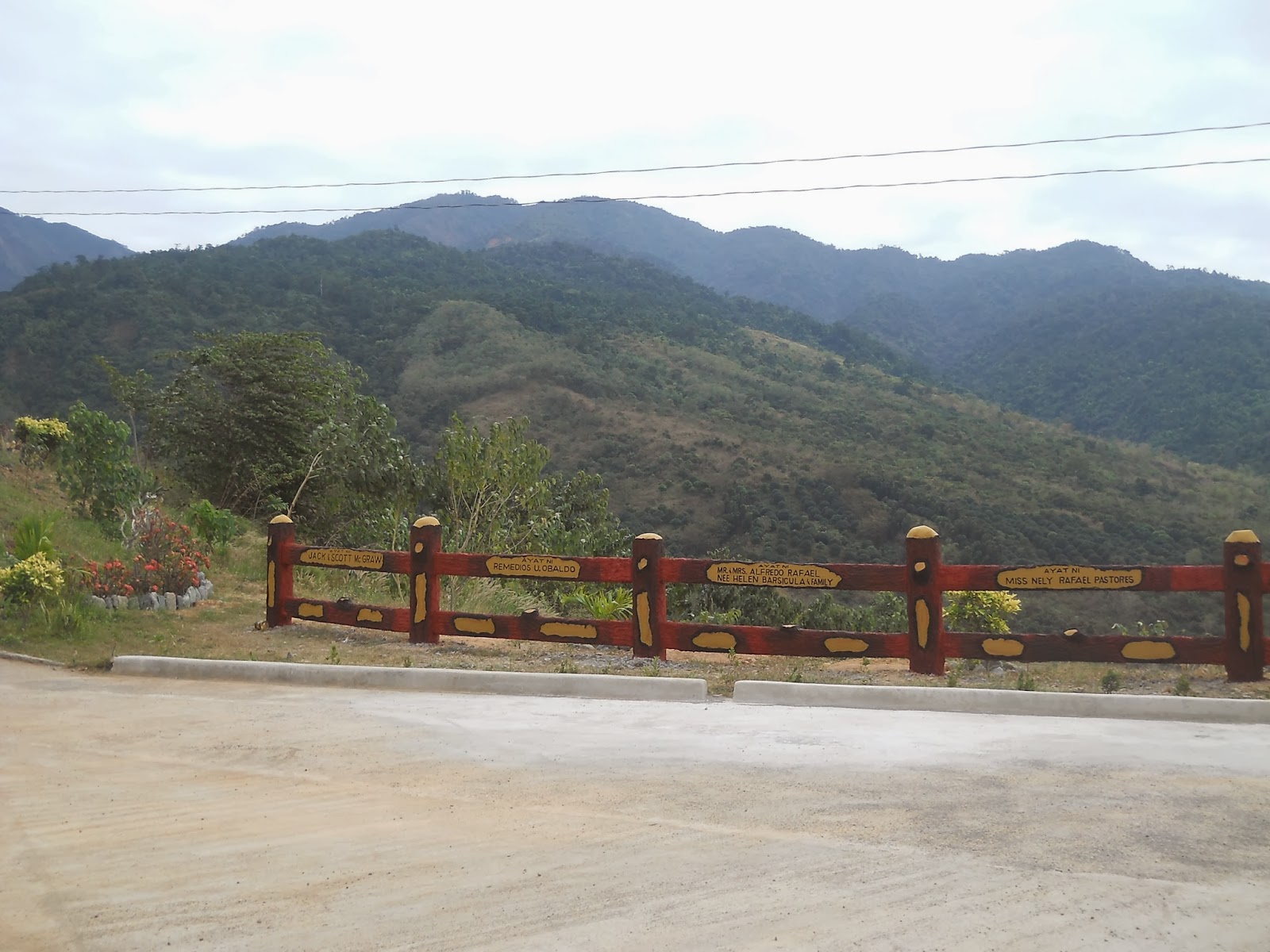
If you’re searching for ultimate adventure here in Pangasinan, Balungao is the best place to be. It is the place that will give you fear, nervousness, excitement and a feeling that is really intense.
To reach the top is the sole aim of the group. This served as our mission as we patiently walk and reach
the peak of a mountain in Natividad, Pangasinan where lies on top the 120 –
meter Sky Plaza, the
latest attraction in this small sixth district town.
Reaching the top signifies success especially when we saw the
breath taking views at the foot of the mountain. We’ve just discovered a
perfect hideaway from the dull and droning life.For only P50, a sports
enthusiast can already enjoy a zipline ride here. The zipline is just one of
the many attractions at the 2.2 hectare Natividad Forest Park. A nursery, water
tank and grotto were earlier put up along with a big white cross at the highest
peak. I suggest that you should have a strong stamina in climbing the highest
peak. JNatividad, a fourth class town, also boasts
of other attractions. A waterfall is just a kilometer away from the forest
park, and boat rides at barangay Rizal.
Aside from this,
Natividad has its different resorts where you can relax and chill after a
tiring day. Sirok ti Manga Resort; Ilocano term for Under the Mango Tree is a
new nature resort located in the foothills of the Caraballo Mountains in this
small, quiet town which is one of the best resorts in town. The SM Resort is
ideal for camping and nature walks. Other facilities set to be built by the
municipal government in the Sirok Manga Resort are a social hall which can
accommodate seminars by government agencies, a few cottages more and a chapel.
Natividad may not be able to compete with its neighboring
towns in urban development but it wants to make its mark as an eco-adventure
tourism site. Natividad is also featured at TalkTV Global via Traveldotcom, a global tourism promotion show
Oftentimes, a pack of noodles is tagged as
unhealthy because of the artificial preservatives it contains. Despite this
description which has been proven to be a fact, many people still resort to
this meal, either as a snack, or as a substitute to lunch and dinner.
No brand of noodles has been highly
recommended by dieticians.
But, in this fast-paced world packed with
immensely remarkable innovations, nothing is impossible. Even the infamous
noodles can take the spotlight on a positive degree. The unhealthy becomes
otherwise.
The Local Government Unit of Alcala,
Pangasinan spearheaded a project for women entrepreneurs in their town to
produce a delectable yet healthy product—the Alcala Veggie Noodles.
Their noodles come in different flavors: squash,
saluyot and malunggay. All the ingredients are fresh vegetables coming from the
town of Alcala.
Ms.Vangie together with the help of her
production staff demonstrated to us the process of noodle-making, from grinding
of vegetables through mixing them with other ingredients to cooking the noodles
in boiling water and deep-frying them in oil.
After the demo, we tasted two veggie noodle
dishes prepared by the team—pancit and spaghetti. It really tastes so good that
those who hate vegetables won’t even notice that they’re eating vegetables, a
viable solution to the problem of parents who are having a hard time feeding
their children with vegetables.
The taste is close to the pancit and
spaghetti we’ve always craved for, but the preparation is way healthier. All
flavors are a must try, but mikilunggay tops the list.
So, if you happen to be on a road trip in
Pangasinan, never miss to visit Alcala and drop by the Alcala Veggie Noodle Processing Plant.
FYI: Aside from noodles, they also veggie breads and crackers that are perfect for snack time.
Pangasinan is known for its beautiful sceneries and nature’s wonders: from cave systems, white sand beaches, islands, falls to its unique and delectable selection of foods.
This January, I was lucky to be one of the few people to experience and taste the mouthwatering delicacies of Pangasinan, thanks to GBG Pangasinan and Dagupan!
GBG Pangasinan and Dagupan spearheaded the event entitled “Pangasinan Food Tour 2014”. The goal of this event is to discover the unique foods offered in the province in preparation for the Pangasinan Food Mapping scheduled on the 1st quarter of the year.
The tour is a 3-day event; it started on January 10, Friday. Alcala was the first stop wherein the locality demonstrated the process of Veggie noodle production. The Veggie Noodle Processing Plant is a project of LGU Alcala for their women entrepreneurs.
They also prepared the famous Filipino delicacy called pancit, and spaghetti made up of veggie noodles which we savored after the demo.And all were all delicious. You won’t even recognize there were vegetables in it, so I recommend it to those parents who has problem feeding their children with vegetables.
After Alcala, we went to Laoac, the home of the tasty tupig, sticky rice logs with coconut cream. Aside the famous tupig, we also tasted the different flavors of fresh milk offered by Laoac’s dairy farm, in which we’ve gotten head to head with the cows that came from Australia.
On our second day, everybody was feeling kind of stuffed already because of the amazing food selection. We started the tour by celebrating with the Pozzorubians on their annual Patupat festival, then immediately proceeded to Mangaldan.
Everyonewent salivating when Ms.Joan started cooking the tapa, one of Cela’s Meat products, (the first destination in Mangaldan), because its aroma was really inviting.In fact, it is the best tapa I ever tasted yet!
After the treat from Cela’s, we went to Romana’s, a peanut brittle retailer, to try some of their sweets.We were already full at the time, but it didn’t stop us from munching in their goods.
Our lunch was big heartedly spent at Kuya Max’Restogrilllocated in Lucao Dist., Dagupan City. Sir Maximo Tan, the owner of the alternative restaurant, let us try his top sellers.First was the refreshing drink concoction called, frozen lemonade, also featured in Phillipine Daily Inquirer. Next was his special pigar-pigar made in imported Angus beef. We were also served with different seafood dishes that are proudly Dagupan.
Don Armandos and Don Vitos Pizza were our next stop for Calasiao. And let me just say, I can’t get enough of their Bangus sinigangsa Buko and Don Vito’s Special pizza. Jech’s, which was a 10 minute- ride away,offered lengua and pancit which I openly recommending for everyone to try.
Our last destination on that day was Rudy Jing’s Eatery which offered clams, inihaw na hito (catfish) andBangus (milkfish), and other seafood dishes, but before going there, we visited Binmaley’s seafood manufacturing area and tasted some of their product samples such as: Siomai Bbangus, Tocino Bangus, Longganisa Bangus, and Shanghai Bangus.
Yoly’s Garden Grill and Resto was our first stop for the last day of the tour. Madam Yoly, the proud owner demonstrated on how they cook their signature dish, the veggie tempura. The tour ended at the famous BangsalLechonand Seafood Restaurant in Binmaley, where they served us they’re 2 boodle dishes, the Sigay boodle and the Chinese boodle.
This was definitely an experience worth keeping and remembering.
I am looking forward on the next Pangasinan Food tour.
The Tagalog word Pasko derives from the
Spanish word Pascua. Although the wordPascua means Easter, Pascua de Navidad
refers to Christmas.
The Philippines is known for having the
world’s longest Christmas season. The four months that end with the syllable
–ber are considered Christmas months, which is why stores and households start
playing carols on the first day of September! And the holiday season extends
beyond December 31st. It doesn’t end until the Feast of the Epiphany or Three
Kings (Tatlong Hari) which falls around January 6.
If Mexico has piñatas, the Philippines
has its parol. Of course, a parol is not something to hit with a stick. It is a
Christmas lantern, most commonly in the shape of a five-pointed star. The
bamboo or rattan frame is covered with rice paper, tissue or cellophane. Almost
every family either builds or buys one to hang by the window or door. Shopping
malls construct giant versions of parol. Traditionally, a candle was placed
inside for light to shine through; for safety reasons, people now use bulbs or
even a flashlight. Families, schools and other places also display a creche or
nativity scene called belen. Christmas trees made of plastic are decorated with
lights, tinsel and balls.
The Tagalog word for gift is regalo,
but Filipinos have a special word for "Christmas gift" — pamasko. The
Filipino version of Secret Santa is called Monito Monita or Kris Kringle. Students
in their classes and office workers all hold gift exchanges during the
Christmas season. Children receive fresh bills of money called aginaldo,
usually when they visit their godparents and elderly relatives on Christmas
morning.
Mostly Catholics, Filipinos begin a
novena (a series of nine masses) on December 16th. The masses are part of the
cherished religious tradition of Simbang Gabi, which literally means “Night
Worship.” Filipinos go to church at four o’clock in the morning and afterward
have breakfast together. A traditional drink during this season is a warm
ginger tea called salabat and a traditional treat is a flat but thick yellow
rice cake called bibingka.
On Christmas Eve (Bisperas ng Pasko), a
few Filipino towns commemorate Joseph and Mary’s search for a place to stay
with a reenactment called panunuluyan, a tradition very similar to the Mexican
posadas.
What every Filipino looks forward to is
Noche Buena, the grand family dinner after the midnight mass. Christmas morning
is the time for visiting relatives. Filipinos wear new if not their best
clothes. Children do mano, which is kissing or bringing to their forehead the
hand of an elderly person. This is when they receive their pamasko,
certainlyaguinaldo from godfathers and godmothers. Christmas lunch and
Christmas dinner are with family.
Here we take a look at some of the yuletide customs observed by our cousins across the globe
From Spain: Saint Nicholas is escorted by his assistants called Zwarte Piet
The Netherlands
Here, the most important day of the festive season is December 5, when Sinterklaas, or St Nicholas, arrives by steamboat from his home in Spain.
Until the 19th Century, Sinterklaas operated along, bringing well-behaved children presents and spiriting bad youngsters away in his sack for re-education and a beating.
However, in 1850, children's author Jan Schenkman drew him with a black servant, who later became known as Zwarte Piet or Black Pete.
It became Zwarte Piet's job to go down the chimney to deliver presents and catch the less fortunate children.
From Spain: Saint Nicholas is escorted by his assistants called Zwarte Piet
Iceland
The land of ice and snow has no fewer than 13 Santa Clauses.
Thirteen days before Christmas, the first Santa descends from the mountains and visits each house to put treats in children's shoes while they sleep.
Well-behaved children get presents such as mandarins, scratch cards and sweets, while bad kids typically receive something less attractive, such as a potato.
The next day the second Father Christmas comes to town and so on.
Then on December 25, the first one goes back, the next day the second one goes back.
January 6 is called "the thirteenth" and is the last day of Christmas because that day the last Santa goes home.
Germany
Here, Christmas Eve is the most important day of the festive season.
Families traditionally mark the occasion with a feast and a visit to church for midnight mass.
Some families will sing at Christmas but in general the mood is one of contemplation and reflection.
Poland
For Polish children presents arrive on December 6.
That's because this is St Nicholas Day, or Sw. Mikolaj Day and St Nicholas is the original Father Christmas.
Unlike Santa in the UK, this character dresses in the white and gold of a Bishop, rather than red and white.
Norway
Here, presents are exchanged on Christmas Eve.
They are sometimes delivered by Santa Claus, although he goes by the name Julenissen.
Gifts are also brought by small gnomes called Nisse.
Many families will leave a sheaf of wheat out for birds to eat over Christmas.
They often also leave out rice porridge for the Nisse who are believed to watch over farm animals.
Argentina
Argentinians decorated their homes with lights and wreaths and hang red and white garlands of flowers on their doors.
Christmas trees are also popular and they are often decorated by December 8 - the feast of the Annunciation, when Christians remember when Mary was told she would have the baby Jesus.
The Nativity scene, or pesebre, is also an important Christmas decoration in Argentina.
Here, the main Christmas meal is eaten during the evening of Christmas Eve.
Popular dishes include roasted turkey, roasted pork, stuffed tomatoes and Christmas bread and puddings like 'Pan Dulce' and Panetone.
People often set off fireworks at midnight and 'toast' the start of Christmas Day.
Australia
Christmas comes in the middle of the summer holidays here.
Australians hang wreaths on their front doors and sometimes go carol singing on Christmas Eve.
People also decorate their houses and gardens with Christmas trees and lights.
Australians also decorate their houses with bunches of 'Christmas Bush', a native tree with small green leaves and cream coloured flowers.
When he gets to Australia, Santa gives the reindeer a rest and uses kangaroos or 'six white boomers'.
Nigeria
Christmas in Nigeria is a family event.
Many families will throw Christmas parties that will last all night long on Christmas Eve, then on Christmas Morning, they go to church to give thanks to God.
Homes and streets are often decorated and most homes have artificial Christmas trees.
Nigerians do eat turkey at Christmas.
However, in addition, a traditional Christmas meal may include beef, goat, sheep, ram or chicken.
Vietnam
In Vietnam Christmas Eve is often more important than Christmas Day.
The country used to belong to France and there are still French influences in its Christmas traditions.
For example, like in France, the special Christmas Eve meal is called 'reveillon' and has a 'bûche de Noël' (a chocolate cake in the shape of a log) for desert.
Vietnamese people like to give presents of food and at Christmas a bûche de Noël is a popular gift.
Santa is called Ông già Noel - which translates as Christmas old man. - DailyMirror
This year Pangasinan tour is one of the lucky blogs to join
the biggest blogging event of the year, the Blogapalooza 2013.
Blogapalooza 2013 is a business – blogger event wherein businesses
promote their products and brands by sharing them to bloggers which is now
tagged as online influencers. This is a great opportunity for business to gain
more exposure since hundreds of bloggers are in attendance.
For fellow bloggers this may serve as a networking opportunity,
meet new faces and talk with business owners and become their client in the
future. Also, a lot of stuffs will be given away for bloggers. Isn't it
Exciting?!